The Probability of Picking a Object and Then Picking It Again
Eugene is a qualified command/instrumentation engineer Bsc (Eng) and has worked as a developer of electronics & software for SCADA systems.
What Is Probability Theory?
Probability theory is an interesting area of statistics concerned with the odds or chances of an effect happening in a trial, due east.g. getting a six when a dice is thrown or drawing an ace of hearts from a pack of cards. To piece of work out odds, we also need to accept an understanding of permutations and combinations. The math isn't terribly complicated, so read on and you might exist aware!
What's covered in this guide:
- Equations for working out permutations and combinations
- Expectation of an event
- Addition and multiplication laws of probability
- General binomial distribution
- Working out the probability of winning a lottery
Definitions
Before we get started let's review a few key terms.
- Probability is a measure of the likelihood of an outcome occurring.
- A trial is an experiment or examination. E.1000., throwing a die or a money.
- The upshot is the result of a trial. E.g., the number when a die is thrown, or the card pulled from a shuffled pack.
- An event is an outcome of involvement. East.thousand., getting a 6 in a die throw or drawing an ace.
- Odds is the probability of an event occurring divided by the probability of information technology not occurring (e.one thousand. 1 to 5 chance of a six in a dice throw)
What Is the Probability of an Upshot?
There are two types of probability, empirical and classical.
If A is the upshot of involvement, then we can denote the probability of A occurring equally P(A).
Empirical Probability
This is determined by carrying out a series of trials. And then, for instance, a batch of products is tested and the number of faulty items is noted plus the number of acceptable items.
If at that place are n trials
and A is the event of interest
Then if issue A occurs x times
P(A) = 10 / n
Example: A sample of 200 products is tested and iv faulty items are found. What is the probability of a product existence faulty?
And then x = 4 and n = 200
Therefore P(faulty item) = 4 / 200 = 0.02 or ii%
If nosotros practice the trial once again with a different number of products, nosotros tin can expect 2% of them to be faulty.
Classical Probability
This is a theoretical probability which can be worked out mathematically.
Scroll to Continue
Read More From Owlcation
If A is the event, then
P(A) = Number of ways the effect can occur / The full number of possible outcomes
Example i: What are the chances of getting a six when a die is thrown?
In this example, there is but 1 way a half dozen can occur and there are half dozen possible outcomes, i.e. 1, ii, 3, four, 5 or half dozen.
So P(6) = 1/6
Instance 2: What is the probability of drawing a 4 from a pack of cards in ane trial?
At that place are 4 means a 4 can occur, i.e. iv of hearts, 4 of spades, four of diamonds or iv of clubs.
Since there are 52 cards, at that place are 52 possible outcomes in 1 trial.
Then P(4) = 4 / 52 = 1 / xiii
What Is the Expectation of an Upshot?
Once a probability has been worked out, it'southward possible to become an estimate of how many events will likely happen in future trials. This is known as the expectation and is denoted past East.
If the upshot is A and the probability of A occurring is P(A), then for N trials, the expectation is:
E = P(A) N
For the simple example of a dice throw, the probability of getting a six is i/6.
And then in 60 trials, the expectation or number of expected vi's is:
Eastward = one/half dozen x sixty = 10
Remember, the expectation is non what will actually happen, but what is probable to happen. In 2 throws of a dice, the expectation of getting a 6 (not two sixes) is:
Due east = one/half dozen x 2 = 1/3
Nevertheless, every bit we all know, it'south quite possible to get ii sixes in a row, even though the probability is only 1 in 36 (see how this is worked out later). Every bit N becomes larger, the actual number of events which happen will go closer to the expectation. So for instance when flipping a coin, if the coin isn't biased, the number of heads will be closely equal to the number of tails.
Success or Failure?
The probability of an event tin can range from 0 to one.
Remember
P(Result) = Number of means the event can occur / The total number of possible outcomes
So for a dice throw
P(getting a number between ane and 6 inclusive) = 6 / 6 = 1 (since there are 6 ways you tin get "a" number between 1 and vi, and half dozen possible outcomes)
P(getting a 7) = 0 / 6 = 0 (there are no ways the upshot seven tin can occur in any of the 6 possible outcomes)
P(getting a 5) = 1 / 6 (only 1 way of getting a 5)
If at that place are 999 failures in 1000 samples
Empirical probability of failure = P(failure) = 999/yard = 0.999
A probability of 0 means that an effect will never happen.
A probability of one means that an outcome will definitely happen.
In a trial, if event A is a success, and then failure is not A (non a success)
and:
P(A) + P(not A) = 1
Independent and Dependent Events
Events are independent when the occurrence of ane upshot doesn't affect the probability of the other outcome.
So if a card is fatigued from a pack, the probability of an ace is 4/52 = 1/13.
If the card is replaced, the probability of drawing an ace is still 1/13.
Two events are dependent if the occurrence of the first upshot affects the probability of occurrence of the second event.
If an ace is drawn from a pack and not replaced, there are only 3 aces left and 51 cards remaining, and then the probability of drawing a 2nd ace is 3/51.
For two events A and B where B depends on A, the probability of Issue B occurring afterward A is denoted by P(B|A).
Mutually Exclusive and Non-Exclusive Events
Mutually sectional events are events that cannot occur together. For instance in the throwing of a dice, a v and a 6 can't occur together. Some other example is picking coloured sweets out of a jar. if an event is picking a ruby sweet, and another outcome is picking a blueish sweet, if a blueish sugariness is picked, it can't also exist a red sweet and vice versa.
Mutually not-sectional results are events that can occur together. For example when a bill of fare is drawn from a pack and the upshot is a blackness card or an ace card. If a black is fatigued, this doesn't exclude it from existence an ace. Similarly if an ace is drawn, this doesn't exclude it from beingness a black carte.
Addition Law of Probability
Mutually exclusive events
For mutually exclusive (they tin can't occur simultaneously) events A and B
P(A or B) = P(A) + P(B)
Case one: A sweet jar contains 20 carmine sweets, 8 green sweets and x bluish sweets. If ii sweets are pickets are picked out, what is the probability of picking a blood-red or a bluish sweetness? (To go on things simple, the kickoff sweet is returned then there are still 38 sweets to choose from when the 2d sweet is picked)
The event of picking out a ruddy sweet and picking out a blue sweetness are mutually sectional.
There are 38 sweets in total, so:
P(red) = 20/38 = 10/nineteen
P(bluish) = x/38 = 5/19
P(red or blue) = P(red) + P(bluish) = 10/nineteen + 5/xix = fifteen/19
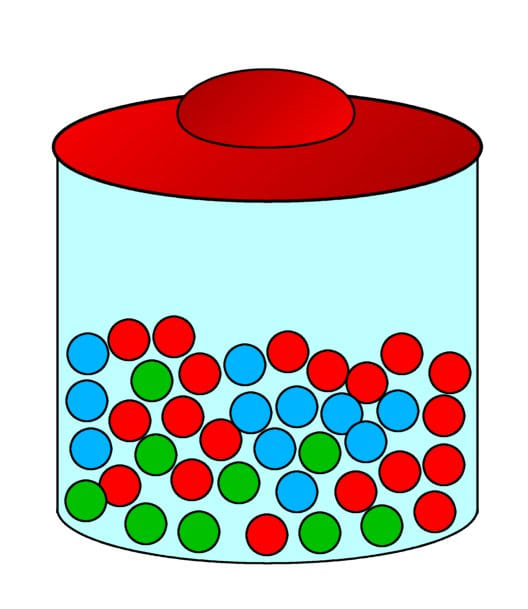
Sweets in a jar
Example 2 : A dice is thrown and a carte is drawn from a pack, what is the possibility of getting a 6 or an ace?
There is only i way of getting a vi, so:
P(getting a 6) is i/6
There are 52 cards in a pack and four ways of getting an ace. As well drawing an ace is an independent effect to getting a 6 (the earlier event doesn't influence it).
P(getting an ace) is iv/52 = 1/xiii
P(getting a half dozen or an ace) = P(getting a six) + P(getting an ace)
= 1/6 + one/13 = (xiii + 6)/78 = nineteen/78
Call up in these type of problems, how the question is phrased is important. So the question was to determine the probability of i event occurring "or" the other issue occurring and so the improver constabulary of probability is used.
Mutually not-exclusive events
If two events A and B are mutually non-exclusive, so:
P(A or B) = P(A) + P(B) - P(A and B)
..or alternatively in set theory notation where "U" means the marriage of sets A and B and "∩" means the intersection of A and B:
P(A U B) = P(A) + P(B) - P(A ∩ B).
We effectively accept to subtract the mutual events that are "double counted". You can think of the two probabilities every bit sets and we are removing the intersection of the sets and calculating the union of set A and fix B.
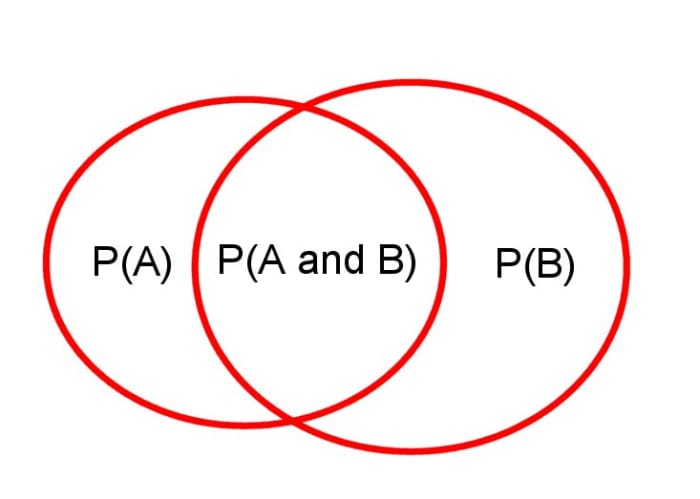
The union of the 2 sets A and B is P(A U B) = P(A) + P(B) - P(A ∩ B)
© Eugene Brennan
Example 3: A coin is flipped twice. Calculate the probability of getting a head in either of the ii trials.
In this case we could become a head in ane trial, in the 2nd trial or in both trials.
Let H1 exist the event of a head in the showtime trial and H2 be the event of a caput in the 2nd trial
P(H1) = 1/2 and P(H2) = 1/ii (there is just one mode a head can occur in each trial and two possible outcomes)
and P(H1 or Hii) = P(Hi) + P(Htwo) - P(H1 and Hii)
There are four possible outcomes, HH, HT, TH and TT and only 1 way heads can announced twice. And then P(H1 and Htwo) = ane/4
And then P(H1 or Hii) = P(H1) + P(H2) - P(Hi and H2) = 1/2 + 1/2 - i/four = 3/four
For more information on mutually non-exclusive events, run across this commodity:
Taylor, Courtney. "Probability of the Union of 3 or More Sets." ThoughtCo, Feb. eleven, 2020, thoughtco.com/probability-union-of-3-sets-more than-3126263.
Multiplication Police force of Probability
For independent (the first trial doesn't affect the second trial) events A and B
P(A and B) = P(A) ten P(B)
Case: A dice is thrown and a menu fatigued from a pack, what is the probability of getting a 5 and a spade carte?
P(getting a 5) = number of ways of getting a 5 / total number of outcomes
= one/6
In that location are 52 cards in the pack and 4 suits or groups of cards, aces, spades, clubs and diamonds. Each suit has xiii cards, so there are 13 ways of getting a spade.
So P(cartoon a spade) = number of ways of getting a spade / total number of outcomes
= thirteen/52 = ane/four
So P(getting a v and drawing a spade)
= P(getting a 5) 10 P(drawing a spade) = 1/6 10 1/4 = i/24
Once again it'south of import to note that the discussion "and" was used in the question, so the multiplication police was used.
Recommended Books
Engineering Mathematics by K.A. Stroud is an splendid math textbook for both technology students and anyone with a general interest in mathematics. The material has been written for role i of BSc. Engineering Degrees and Higher National Diploma courses.
A wide range of topics are covered including matrices, vectors, circuitous numbers, calculus, calculus applications, differential equations and series. The text is written in the style of a personal tutor, guiding the reader through the content, posing questions and encouraging them to provide the answer. Personally, I've found it actually easy to follow.
It as well covers a more in-depth treatment of probability theory than what has been covered in this article plus a section on statistics.
This book basically makes learning mathematics fun!
Note: Second hand 1987 editions of this text book are bachelor on Amazon for only almost $6
Amazon
Summary of Probability Rules
Rule 1:
The probability of an result has a value between 0 and ane inclusive:
0 ≤ P(A) ≤ 1
Rule 2:
The sum of all probabilities adds up to one
If Ā is the compliment of A, or "not" A, i.due east. event A not occurring, P(Ā) is the probability of A not occurring (or Ā occurring):
P(Ā) + P(A) = 1
Rule 3:
It follows from dominion 2 that the probability of an event not occurring is 1 - the probability of it occurring:
P(Ā) = 1 - P(A)
Rule 4:
For two events A and B:
P(A and B) = P(A) x P(B)
Dominion 5:
For mutually exclusive events A and B
P(A or B) = P(A) + P(B)
Dominion 6:
For non mutually exclusive events:
P(A or B) = P(A) + P(B) - P(A and B)
= P(A) + P(B) - P(A) x P(B)
Permutations and Combinations
To solve more difficult bug and derive an expression for the probability of a general binomial distribution, we need to empathize the concept of permutations and combinations. I won't go into the mathematics of the derivation, only basically the expression is derived from the equation for working out combinations.
A Permutation Is an Arrangement
A permutation is a way of arranging a number of objects. So, for instance, if you accept the messages A, B, and C then all the possible permutations are:
ABC, ACB, BAC, BCA, CAB, CBA
Note that BA is a dissimilar permutation to AB.
If y'all have n objects, there are due north factorial number of ways of arranging them, written every bit n!
n! = n 10 (north-ane) x (n-ii) .... x iii x 2 x ane
The reason for this is because for the outset position, in that location are n choices, and for each of these choices, there are (n-ane) choices for the second place (because 1 choice was used up for the start identify), and for each of the choices in the start 2 places, (n-three) choices for the third place and so on.
In the case to a higher place, the three messages A, B, C could be arranged in iii! = 3 x two x 1 = 6 means
In general, if due north objects are selected r at a time so, the number of permutations is:
northward! / (northward-r)!
This is written as nPr
Example: 2 messages are chosen from the set of letters A, B, C, D. How many ways can the 2 messages be bundled?
There are four letters and then n =iv and r = ii
nPr = 4Pii = four! / (4 - 2)! = 4! / 2! = 4 x 3 ten 2 x 1 / ii ten 1 = 12
A Combination Is a Option
A combination is a way of selecting objects from a set up without regard to the guild of the objects. Then again if we take the letters A, B and C and select 3 messages from this prepare, at that place is just 1 way of doing this, i.e. select ABC.
If we select 2 letters at a fourth dimension from ABC, all the possible selections are:
AB, Ac, and BC
Remember, BA is the aforementioned selection as AB etc.
In general, if you have due north objects in a ready and make selections r at a time, the total possible number of selections is:
nCr = northward! / ((n - r)! r!)
Example: two letters are called from the set ABCD. How many combinations are possible?
There are four letters so n = 4 and r = 2
northwardCr = ivCtwo = 4! / ( (4 - two)! x ii!) = 4! / (2! ten 2!)
= 4 x 3 x ii x 1 / ( (ii x 1) x (2 x 1) ) = half-dozen
Full general Binomial Distribution
In a trial, an event could be getting heads in a coin throw or a half-dozen in a throw of a dice.
If the occurrence of an event is defined equally a success, then
Let the probability of success be denoted by p
Allow the probability of non-occurrence of the event or failure be denoted by q
p + q = 1
Let the number of successes be r
And n is the number of trials
And then

Equation for binomial distribution
© Eugene Brennan
Example: What are the chances of getting iii sixes in 10 throws of a die?
At that place are 10 trials and iii events of interest, i.e. successes so:
n = ten
r = 3
The probability of getting a 6 in a dice throw is 1/6, so:
p = 1/6
The probability of not getting a dice throw is:
q = 1 - p = 5/6
P(3 successes) = ten! / ((10 - iii)! iii!) ten (five/6)(10 - iii) x (ane/half-dozen)3
= x! / (vii! x 3!) x (5/6)7 10 (1/6)3
= 3628800 / (5040 10 6) x (78125 / 279936) x (1/216)
= 0.155
Note that this is the probability of getting exactly three sixes and not any more than or less.
Winning the Lottery! How to Work out the Odds
Nosotros would all like to win the lottery, merely the chances of winning are only slightly greater than 0. However "If you're non in, you tin can't win" and a slim chance is amend than none at all!
Accept, for example, the California Country Lottery. A player must cull 5 numbers between ane and 69 and ane Powerball number between 1 and 26. So that is effectively a 5 number selection from 69 numbers and a one number option from 1 to 26. To summate the odds, we need to work out the number of combinations, not permutations, since information technology doesn't matter what way the numbers are arranged to win.
The number of combinations of r objects is due northCr = north! / ((north - r)! r!)
n = 69
and
r = 5
and
due northCr = 69Cv = 69! / ( (69 - 5)! 5!) = 69! / (64! 5!) = 11,238,513
So there are eleven,238,513 possible ways of picking 5 numbers from a choice of 69 numbers.
Merely 1 Powerball number is picked from 26 choices, then at that place are but 26 ways of doing this.
For every possible combination of 5 numbers from the 69, there are 26 possible Powerball numbers, then to get the total number of combinations, nosotros multiply the two combinations.
Then the total possible number of combinations = 11,238,513 x 26 = 292,201,338 or roughly 293 million and the probability of winning is ane in 293 million.
References:
Stroud, Grand.A. (1970). Engineering Mathematics (3rd ed., 1987). Macmillan Education Ltd., London, England.
This article is authentic and true to the best of the author's knowledge. Content is for informational or entertainment purposes only and does non substitute for personal counsel or professional advice in concern, financial, legal, or technical matters.
Questions & Answers
Question: Each Sign has twelve different possibilities, and there are three signs. What are the odds that any two people volition share all three signs? Annotation: the signs tin can be in different aspects, but at the end of the day each person is sharing three signs. For example, one person could take Pisces every bit Sun sign, Libra as Rising and Virgo as Moon sign. The other party could take Libra Sun, Pisces Rise, and Virgo moon.
Reply: In that location are twelve possibilities, and each can have 3 signs = 36 permutations.
Just only half of these are a unique combination (e.m., Pisces and Sun is the same as Sun and Pisces)
so that's 18 permutations.
The probability of a person getting 1 of these arrangements is i/eighteen
The probability of 2 people sharing all 3 signs is 1/xviii ten 1/xviii = i/324
Question: I am playing a game with 5 possible outcomes. Information technology is assumed that the outcomes are random. For sake of his argument allow u.s.a. call the outcomes 1, 2, 3, 4 and 5. I take played the game 67 times. My outcomes have been: 1 18 times, 2 nine times, 3 zero times, 4 12 times and 5 28 times. I am very frustrated in not getting a 3. What are the odds of not getting a 3 in 67 tries?
Answer: Since you carried out 67 trials and the number of 3s was 0, and so the empirical probability of getting a 3 is 0/67 = 0, so the probability of not getting a 3 is 1 - 0 = 1.
In a greater number of trials in that location may be an effect of a three so the odds of non getting a iii would exist less than 1.
Question: What if someone challenged you to never roll a three? If you were to roll the dice 18 times, what would be the empirical probability of never getting a three?
Respond: The probability of not getting a three is 5/vi since at that place are five means you tin not go a 3 and in that location are six possible outcomes (probability = no. of ways result tin can occur / no of possible outcomes). In two trials, the probability of non getting a 3 in the commencement trial AND not getting a three in the second trial (emphasis on the "and") would be 5/6 x v/half-dozen. In 18 trials, you keep multiplying 5/6 past 5/6 so the probability is (v/6)^eighteen or approximately 0.038.
Question: I take a 12 digit keysafe and would like to know what is the best length to set to open 4,five,6 or 7?
Answer: If you mean setting 4,5,6 or vii digits for the code, vii digits would of course accept the greatest number of permutations.
Question: If you have nine outcomes and y'all need iii specific numbers to win without repeating a number how many combinations would there be?
Answer: It depends on the number of objects n in a set.
In full general, if you accept north objects in a fix and brand selections r at a time, the total possible number of combinations or selections is:
nCr = northward! / ((n - r)! r!)
In your instance, r is 3
Number of trials is 9
The probability of any particular consequence is 1/nCr and the expectation of the number of wins would be 1/(nCr) x ix.
© 2022 Eugene Brennan
Eugene Brennan (author) from Ireland on May 08, 2019:
Not offhand. Even so I did a quick Google search for "games of chance probability books" and several were listed. Maybe you could check them out on Amazon and there might be customer reviews.
maurrice on May 08, 2019:
Give thanks you Eugene for this tutorial. Very Interesting! Do you recommend whatsoever volume which goes into more detail, ideally exploring games of gamble, sports books etc?
Eugene Brennan (author) from Ireland on April 30, 2019:
Hello maurrice,
The probability of the event is one/half-dozen, and then in sixty trials, the probability of that effect is 1/6 + 1/6 + ane/6....... 60 times.
It's an "or" situation, so it'south the probability of that event occurring in trial 1 or trial 2 or trial three etc upwardly to trial sixty.
So you lot add together the probabilities.
If for example you throw a dice and the consequence is getting a vi. Then if the question was "what is the expectation of getting a 6 in each trial", then you would multiply the probabilities because it's an "and" state of affairs.
So information technology'southward the probability of a vi in trial 1 and a 6 in trial 2 etc
= ane/6 ten ane/6, sixty times = 1/vi ^ 60
In general,
Probability = number of ways event tin occur / number of possible outcomes.
So taking the dice example over again:
In ii trials there's 12 ways you can get a 6:
one) 6 in the commencement trial and vi other numbers in the second trial (6 possibilities)
ii) 6 in the 2d trial and 6 other numbers in the first trial (half-dozen possibilities)
The number of outcomes is 6 x 6 = 36
Since if you get 1 in the first trial, you can go i to 6 in the 2nd trial
If you lot get two in the get-go trial, you tin get 1 to half-dozen in the second trial and and then on.
So probability = 12/36 = 1/3
So y'all get the same answer equally by adding the probabilities because it's an "or" situation
1/6 + 1/six = one/3
maurrice on April 29, 2019:
From the post-obit section: What Is the Expectation of an Issue?
Why is the answer calculated every bit 1/6 10 60?
Isn't information technology the same probability per trial, i.e.:
1st trial = 1/6 chance of getting any number
2d trial = i/6 take a chance of getting any number
and and then on...
Therefore, why is information technology not calculated as (i/6)^lx? What am I missing out/confusing, please?
Thanks.
Ekki on Nov 29, 2018:
Cheers and so much for this article. It was most helpful. It answered questions that bothered me since the days in college!
Eugene Brennan (writer) from Republic of ireland on January 24, 2016:
Thanks Larry!
Larry Rankin from Oklahoma on January 24, 2016:
Wonderful insight into odds.
Eugene Brennan (author) from Republic of ireland on January 21, 2016:
Thanks LM, I learned this stuff in school over 30 years ago, but it was refreshing to revisit it!
LM Gutierrez on January 21, 2016:
Thanks for sharing and reiterating the basic mathematics nosotros acquire in our early on years of schooling! Actually, this topic is very useful in real life even if yous engange in a field which does not deal much on numbers such as mine. I concord with Jodah, well-researched hub!
Eugene Brennan (author) from Ireland on Jan 18, 2016:
Thank you Jodah and well spotted! That's what I get for racing through the proof reading!
John Hansen from Gondwana State on Jan 18, 2016:
Information technology's squeamish to know these equations and the odds of throwing certain numbers of dice, cartoon a certain bill of fare etc. Very well researched hub , Eugene. However under the heading "Probability of an Result" it says; "There are two types of probability, empirical and empirical."(should the second one be "classical"?)
Source: https://owlcation.com/stem/How-to-Work-Out-Odds-Permutations-and-Combinations
0 Response to "The Probability of Picking a Object and Then Picking It Again"
Post a Comment